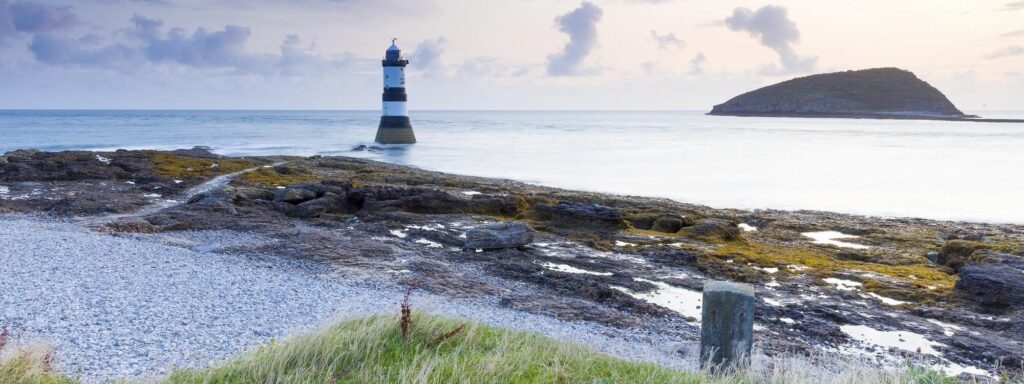
2020 has not been the year that we had planned, but its certainly time to “lockdown” your wish list of places to visit once all the travel restrictions are lifted! A good place to start would be a trip to Anglesey, an island rich in history and beauty. Its coastline is simply stunning and perfect for some well-earned Vitamin Sea for you and your family.
Discover beaches and cliffs, tiny fishing coves and busy ports before arriving at Penmon Point, also known as Black Point, or Trwyn-du in Welsh, situated on the south-east corner of Anglesey and overlooking the Menai Straits, the Irish Sea and Puffin Island. The name derives from Welsh: pen (which can mean “head”, “end” or “promontory”) and Môn, which is the Welsh name for Anglesey.
The first lighthouse at Pen Mon was erected in 1838 at a cost of £11,589, following years of calls for a navigational light at this hazardous stretch of coastline. Master mariners from the busy port of Liverpool were particularly vocal, especially after the tragic wreck of the Rothsay Castle in 1831. The steamer ran aground on the nearby Lavan Sands, breaking apart with the loss of 130 lives and underscoring the urgent need for improved coastal safety.
The present Pen Mon Lighthouse was constructed between 1835 and 1838. Standing 29 metres tall, it was designed by renowned engineer James Walker and marked his first sea-washed tower. The structure later served as a prototype for his more ambitious lighthouse on the Smalls, off the Pembrokeshire coast.
Built to withstand the full force of the Irish Sea, the lighthouse features a distinctive stepped base. This innovative design helped break up the powerful waves that had damaged earlier structures on the site, reducing the impact of surging water at the foot of the tower.
Unlike many rock lighthouses of the period, Pen Mon has austere vertical walls rather than elegant curves – likely an economical decision. A crenellated stone parapet replaces the more common iron railings, and the tower narrows above its halfway point, both features typical of Walker’s later designs. The lighthouse is instantly recognisable by its three original black bands painted on a white background, and it also bears the warning “NO PASSAGE LANDWARD” on both its north and south faces.
James Walker was also responsible for an early – and ultimately unsuccessful – attempt at installing a water closet within the lighthouse. This consisted of a specially designed drain exiting at the base of the tower. While the stepped design may have aided drainage, heavy seas often forced water back into the system, making it impractical during rough weather.
Originally, the lighthouse was illuminated by a four-wick Argand lamp housed within a first-order fixed catadioptric optic manufactured by Isaac Cookson & Co. The light displayed was a fixed red beam, guiding vessels safely past this treacherous headland.
The best way to truly experience Anglesey – and enjoy a visit to Pen Mon Lighthouse – is to stay and explore at your leisure. Spend a few relaxing nights, or even a full week, at Ogwen Bank Holiday Park. Unwind in a luxury lodge with a hot tub in the evenings, then head out during the day to discover the stunning coastline, historic landmarks and natural beauty of North Wales.
Visitor information:
Access to the lighthouse is via a private toll road, with a charge of £3.50. For sat nav users, the nearest postcode is LL58 8RR.